
LAYERS:
Women in design; a magazine from women, for women.
LAYERS:
Women in design; a magazine from women, for women.
LAYERS:
Women in design; a magazine from women, for women.
Context
01/04
Context
01/04
Context
01/04
Layers is a magazine that explores gender inequality within the design industry through both data and lived experience. While the creative industries are often perceived as progressive, persistent gaps remain in hiring processes, pay, and access to leadership positions. This publication brings these structures into focus by combining research, interviews, and personal stories from women working in the field. The entire publication is done in collaboration with Mia Haendel.
Layers is a magazine that explores gender inequality within the design industry through both data and lived experience. While the creative industries are often perceived as progressive, persistent gaps remain in hiring processes, pay, and access to leadership positions. This publication brings these structures into focus by combining research, interviews, and personal stories from women working in the field. The entire publication is done in collaboration with Mia Haendel.
Layers is a magazine that explores gender inequality within the design industry through both data and lived experience. While the creative industries are often perceived as progressive, persistent gaps remain in hiring processes, pay, and access to leadership positions. This publication brings these structures into focus by combining research, interviews, and personal stories from women working in the field. The entire publication is done in collaboration with Mia Haendel.
Process
02/04
Process
02/04
Process
02/04
Layers began with a simple question: Is the design industry equal? Our magazine investigates gender inequality in the design field by focusing on hiring, pay, and leadership opportunities in Sweden and Denmark. After exploring data and existing studies, we realized statistics alone couldn’t capture the lived experiences behind inequality. We wanted to move away from abstract numbers and instead create something human and reflective. This led to the idea of a printed magazine combining data, interviews, and personal insights to create something that invites slower, deeper engagement.
Layers began with a simple question: Is the design industry equal? Our magazine investigates gender inequality in the design field by focusing on hiring, pay, and leadership opportunities in Sweden and Denmark. After exploring data and existing studies, we realized statistics alone couldn’t capture the lived experiences behind inequality. We wanted to move away from abstract numbers and instead create something human and reflective. This led to the idea of a printed magazine combining data, interviews, and personal insights to create something that invites slower, deeper engagement.
Layers began with a simple question: Is the design industry equal? Our magazine investigates gender inequality in the design field by focusing on hiring, pay, and leadership opportunities in Sweden and Denmark. After exploring data and existing studies, we realized statistics alone couldn’t capture the lived experiences behind inequality. We wanted to move away from abstract numbers and instead create something human and reflective. This led to the idea of a printed magazine combining data, interviews, and personal insights to create something that invites slower, deeper engagement.
Content
03/04
Content
03/04
Content
03/04
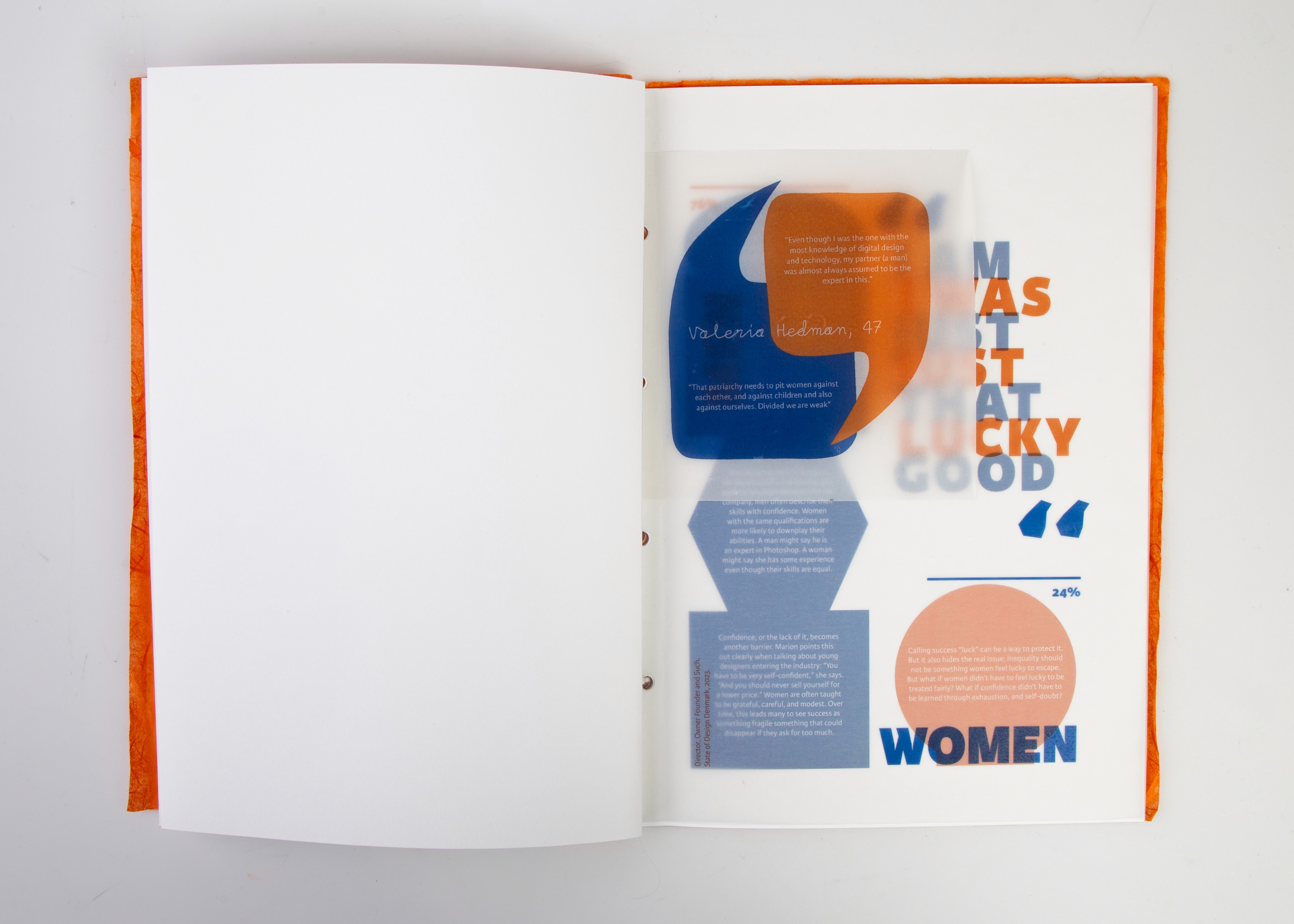
The first issue of Layers gathers real stories from women working in design. We conducted two key interviews with Marion, a German freelance designer with two decades of experience in publishing, and Rebecca, co‑founder of a Copenhagen studio alongside a set of questionnaire responses from Europe‑based designers. The issue also includes an Editors’ Letter, personal reflections, data visualisations, and a Manifesto. Designed as an ongoing publication, Layers seeks to build confidence, foster community, and support aspiring non-male designers as they enter the industry.
The first issue of Layers gathers real stories from women working in design. We conducted two key interviews with Marion, a German freelance designer with two decades of experience in publishing, and Rebecca, co‑founder of a Copenhagen studio alongside a set of questionnaire responses from Europe‑based designers. The issue also includes an Editors’ Letter, personal reflections, data visualisations, and a Manifesto. Designed as an ongoing publication, Layers seeks to build confidence, foster community, and support aspiring non-male designers as they enter the industry.
The first issue of Layers gathers real stories from women working in design. We conducted two key interviews with Marion, a German freelance designer with two decades of experience in publishing, and Rebecca, co‑founder of a Copenhagen studio alongside a set of questionnaire responses from Europe‑based designers. The issue also includes an Editors’ Letter, personal reflections, data visualisations, and a Manifesto. Designed as an ongoing publication, Layers seeks to build confidence, foster community, and support aspiring non-male designers as they enter the industry.
LAYERS
LAYERS
LAYERS




Reflection
04/04
Reflection
04/04
Reflection
04/04
Working on Layers revealed that structural inequality is best understood through personal voices, not only data. The project became a platform for connection for young designers like us and for women already working in the field. While we can’t solve inequality, we can question, communicate, and support each other. Layers encourage readers to see fairness not as luck, but as something that should simply be expected.
Working on Layers revealed that structural inequality is best understood through personal voices, not only data. The project became a platform for connection for young designers like us and for women already working in the field. While we can’t solve inequality, we can question, communicate, and support each other. Layers encourage readers to see fairness not as luck, but as something that should simply be expected.
Working on Layers revealed that structural inequality is best understood through personal voices, not only data. The project became a platform for connection for young designers like us and for women already working in the field. While we can’t solve inequality, we can question, communicate, and support each other. Layers encourage readers to see fairness not as luck, but as something that should simply be expected.